The pastor posed the question: “when was the birth of the church?”
Pentecost, or Resurrection Sunday?
It is a reasonable starting point, but the question invites us to go further back — much further. To answer it properly, we must follow the thread not merely into history but into eternity itself.
My contention is that Genesis 3:15, the protoevangelium, is the first revelation within time of what God purposed before time. The seed of the woman who will crush the serpent’s head is not a contingency plan — it is the unveiling of something already settled. But even Genesis 3 is not the origin. The origin lies in the eternal covenant between the Father and the Son, the pactum salutis, before a single atom of creation existed. The church was chosen in him before the foundation of the world (Ephesians 1:4). Grace was given to us in Christ Jesus before the ages began (2 Timothy 1:9). The birth of the church, at its deepest root, is an eternal event.
Pentecost as Manifestation, Not Origin
The sending of the Holy Spirit in Acts 2 is the manifestation of that eternal purpose breaking into history with full, public force. The gift of tongues is not merely a reversal of Babel — though it is that. It is the announcement that the gospel is now available to all men, in every language, without restriction. The partition has come down, the temple veil is torn. The message that was entrusted to one nation is now entrusted to every nation.
This connects directly to the angelic declaration of Luke 2:13–14. The heavenly host erupted in praise at the birth of Jesus, announcing peace on earth among those with whom God is pleased. That word — eudokia, the good pleasure of God — is not a vague sentiment. It is the declaration that the basis for peace between God and man has entered the world. The wrath humanity earned has a resolution. The angels knew what this meant before the disciples did.
By Acts 2, what the angels announced at the manger is now being applied and proclaimed through the Spirit. Pentecost is the activation of the peace declared in Luke 2. The heavenly hosts rejoice because the demeanour of God toward humanity is now peace — and through the gift of tongues, that peace is announced to the whole world simultaneously.
All the World’s a Stage
Shakespeare wrote that all the world’s a stage. He meant it as a meditation on the brevity and role-playing of human life. But there is a deeper truth in the image than Shakespeare intended.
The material creation is not an accident. It is not merely a habitat for humanity, nor simply the backdrop to the salvation story. It is purposefully designed as the theatre in which the eternal purpose is performed — and the audience is not only human. The stage was built for a cosmic display.
This reframes Genesis 1. The six days of creation are not simply God furnishing a home for his creatures. He is constructing the stage. Light, land, sea, stars, living things — all of it is set-dressing for a drama that was purposed before any of it existed. The material realm carries cosmic-revelatory significance in its very structure.
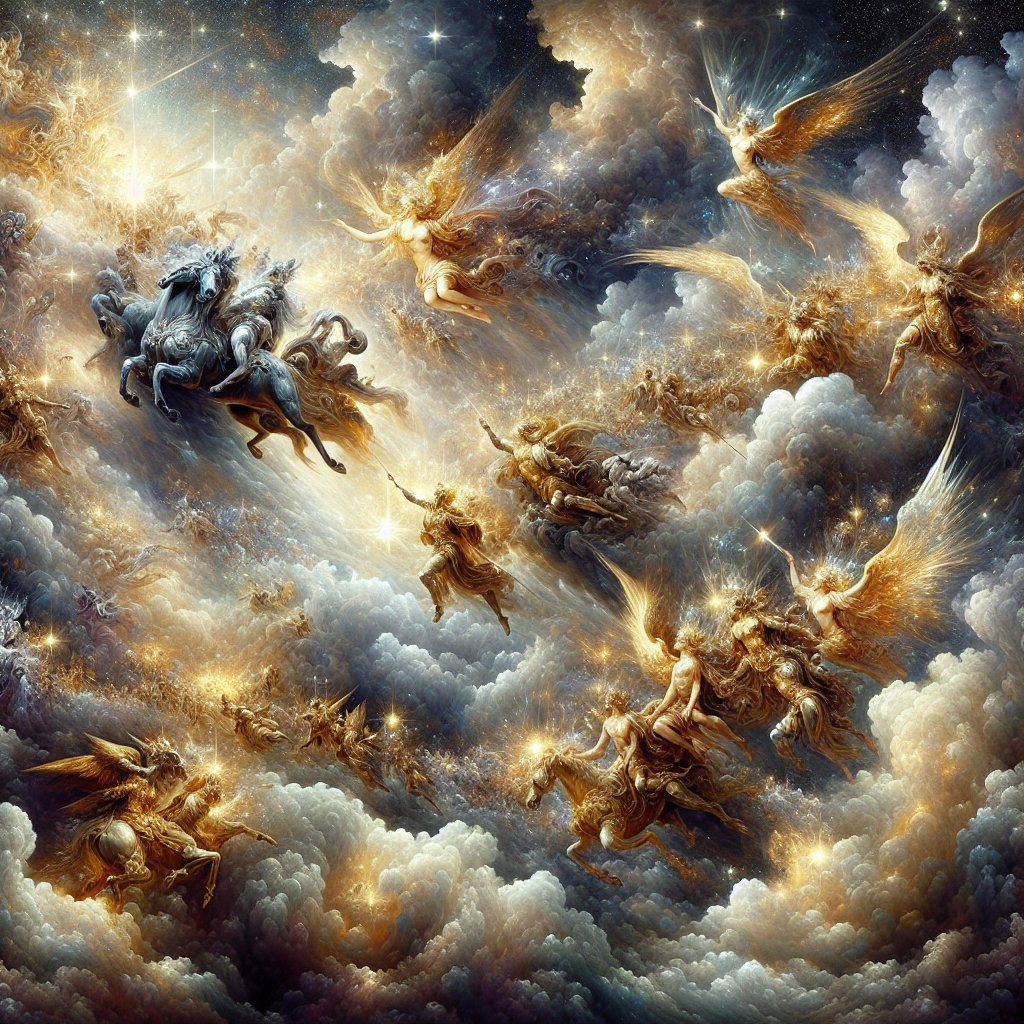
The heavenly hosts, both loyal and rebellious, have been watching the performance unfold since the beginning.
The Progressive Unveiling to the Heavenly Council
The drama has been running on two tracks simultaneously.
To humanity — through promise, covenant, law, prophecy, incarnation, cross, resurrection, Pentecost. The redemptive-historical arc familiar to every student of Scripture.
To the heavenly council — the same events, read by powers who have been watching God’s response to their rebellion unfold in real time. The rebellious members of the divine council who instigated and observed the flood, and the scattering at Babel, the assignment of the nations, and the election of Israel — and interpreted each as a partial victory or manageable setback. What they did not anticipate was the cross.
Paul is explicit: the wisdom of God is “a secret and hidden wisdom… which none of the rulers of this age understood, for if they had, they would not have crucified the Lord of glory” (1 Corinthians 2:7–8). The rebellious council played directly into the eternal purpose. They thought they were shutting down the drama. They were completing it.
And then Pentecost arrives. The Spirit descends. The church is born into history. And Paul declares the purpose of this new community: “so that through the church the manifold wisdom of God might now be made known to the rulers and authorities in the heavenly places” (Ephesians 3:10). The church is not only God’s instrument for reaching humanity. It is the display case of the eternal purpose to the entire heavenly realm. The penny drops for everyone — heaven and earth alike — at the same moment.
The New Creation: The Drama Continues
If the material creation is the stage, then the new creation expands and magnifies the drama.
Ephesians 2:7 looks forward to “the coming ages” in which God will show “the immeasurable riches of his grace in kindness toward us in Christ Jesus.” Not a single age. Ages — plural — stretching out indefinitely. The display of grace is not a one-time announcement. It is an ongoing, ever-deepening revelation of what God is like, expressed on a stage rebuilt and magnified beyond current comprehension.
Paul quotes Isaiah in 1 Corinthians 2:9: “What no eye has seen, nor ear heard, nor the heart of man imagined, what God has prepared for those who love him.” Eye, ear, imagination — all three faculties of human perception named and declared insufficient for what is coming. Whatever the new heavens and earth hold, they will be the stage upon which the grace of God is expressed and displayed to all creation in dimensions we cannot currently process.
The framework holds from beginning to end:
Eternity past — the purpose formed in the covenant between Father and Son
Creation — heavenlies and earthly, is the stage constructed for the drama
History — is the progressive unveiling to humanity and the heavenly hosts simultaneously
Pentecost — the eternal purpose revealed and announced the the entire creation
The church — the ongoing display of God’s manifold wisdom to the world and the heavenly hosts
New creation — the same stage, rebuilt and magnified, the drama entering dimensions beyond current perception
The rebellious council members who thought they were disrupting God’s purpose were, without knowing it, contributing to the performance. That is the manifold wisdom of God. That is what the angels long to look into. That is what the coming ages will unfold, age after age, on a stage designed before the foundation of the world.
A reflection from Graeme Henderson— developed in conversation with Claude AI , 24 May 2026
A reflection on quantum reality, mathematical truth, and what it means to be a creature who can examine the universe from the inside.
Someone sent me a video this week about quantum entanglement. It was a good explainer — clear, honest about the strangeness, careful not to oversell the mystical implications. But even in trying to close the door on those implications, it kept reopening them.
The video made the point that at the most fundamental level, reality is not made of things. It’s made of relationships. Particles don’t have definite properties until they interact. The correlations between entangled particles aren’t transmitted through space — the particles aren’t two separate things exchanging signals. They’re one system expressing itself in two locations. Separation, it turns out, may not be as fundamental as we assumed.
This is where the physics starts to press on something larger.
If It’s Relational All the Way Down
The classical picture of the universe was mechanical. Objects with definite properties, sitting in definite locations, interacting through forces that travel at finite speed. Reality as a vast and precise machine.
Quantum mechanics dismantled that. Not by replacing it with chaos, but by revealing that what looked like the foundation is actually an emergent layer. The stable, object-based world we experience is real — but it’s derivative. Beneath it is something that doesn’t behave like objects at all. Beneath it is a substrate of relationships, correlations, and unresolved potentials that only settle into definite form through interaction.
And here’s what that implies: the most fundamental layer of physical reality is already immaterial.
Not immaterial in the sense of vague or ghostly. Immaterial in the precise sense that it isn’t made of stuff. It’s made of structure, information, relationship. The quantum field isn’t a thing you could pick up. It’s a mathematical description of potentials and correlations. John Wheeler, one of the great physicists of the twentieth century, spent his later years arguing for what he called “it from bit” — the idea that physical reality emerges from information, not the other way around.
If that’s true, then asking whether there is a non-physical realm isn’t a category error. It’s almost inevitable. Because you’re already committed to an immaterial substrate as the ground of everything physical.
The Problem with Mathematics
This is where the mathematics question becomes unavoidable.
Physics describes the world in mathematics. That’s unremarkable on its face — we invented mathematics as a tool, and we use it to model what we observe. But the deeper you go, the harder that explanation is to maintain.
Eugene Wigner, Nobel laureate in physics, wrote an essay in 1960 that has never been satisfactorily answered. He called it “The Unreasonable Effectiveness of Mathematics.” The problem is simple: mathematicians routinely develop abstract structures with no physical application in mind — number theory, non-Euclidean geometry, group theory — and then decades or centuries later, physicists discover that these structures are exactly what they need to describe something real. Not approximately right. Exactly right. The mathematics wasn’t fitted to the physics. It was already there, waiting.
This is very hard to explain if mathematics is just a human invention. If we made it up, why does the universe keep conforming to structures we developed for purely abstract reasons?
The alternative is the position philosophers call mathematical Platonism: mathematical objects are discovered, not invented. The relationships were there before anyone described them. The equations that govern quantum fields didn’t come into existence when Schrödinger wrote them down. He found them.
But if mathematics exists independently of any human mind — if it’s encountered rather than constructed — then you’re committed to something remarkable. There is a realm of abstract, immaterial, necessary existence that precedes and underlies the physical universe. The numbers don’t depend on us. The relationships are just there.
And then the question that won’t go away: in whose mind do they exist?
Necessary, eternal, immaterial existence that is the precondition for everything else — that’s not nothing. Augustine got to this from a different direction. He couldn’t locate eternal truths in any human mind or in any physical object. They weren’t in the world, and they weren’t in him. So he located them in God. The rational ordering principle that underlies all things. The mind in which mathematical structure is native rather than discovered.
John 1 isn’t only poetry. Through him all things were made. The logos — the rational ordering principle — is the ground in which mathematical truth lives. When a physicist does mathematics, they are tracing the structure of a mind that precedes the universe.
The Glory of Kings
Which brings me to Proverbs 25:2.
It is the glory of God to conceal things, but the glory of kings is to search things out.
That verse is doing more work than it looks like. The concealment isn’t obstruction. It’s invitation. God hides things gloriously — not to prevent discovery but to call forth the searching. The hiddenness is the honour. And the searching, correspondingly, is the glory of kings.
We are made in the image of the one who conceals, and given the mandate to search. That’s not incidental. It’s structural to what we are. The dominion mandate of Genesis 1 — to have dominion over the earth, to name and order and steward — is the same impulse that drives science. To examine, to understand, to bring what is hidden into the light of comprehension. That’s not a secular activity that happens to be permitted. It’s a participation in the divine concealment-and-revelation dynamic.
And here’s what makes this remarkable: we are not outside observers doing the examining.
We are made of the same fabric we’re interrogating.
The carbon in our bodies came from stellar nucleosynthesis. The atoms in our hands are governed by the same quantum fields we’re trying to understand. We are — in the most literal physical sense — continuous with the universe we’re studying. We didn’t arrive from somewhere else to look at it. We grew out of it.
And yet, from within it, made of it, we can interrogate the structure of quantum fields. We can ask why mathematics is unreasonably effective. We can notice that the substrate of reality is relational and immaterial. We can follow those observations to their implications.
C.S. Lewis made a parallel move in a different domain. He argued that the one place we have genuine inside access — human experience, conscience, moral intuition — we find not chaos, but law. Not a law we invented. A law that impinges on us. It presses from outside even though it surfaces from within. We didn’t construct the moral law. We encounter it. We find ourselves obligated by something we didn’t author.
The moral law, like mathematical truth, is discovered rather than invented. We find it; we don’t make it. And two independent lines of inquiry — the mathematical structure of the physical world, and the moral structure of human experience — converge on the same conclusion. There is a rational, moral, necessary reality that precedes and grounds everything else.
What This Means
The Christian metaphysic doesn’t have to fight the physics. It turns out to be a better fit for what the physics is actually describing than materialism is.
Materialism has to explain how immaterial information and relationships give rise to solid objects, and why mathematical structure that precedes any physical instantiation happens to govern that physics so precisely, and why creatures who evolved for survival on a savanna can interrogate quantum fields at all. These are not easy questions for a worldview that starts with matter as the fundamental reality.
The biblical framework starts with the immaterial relational as primary. In the beginning, God. Not matter. Not even a void waiting to be filled. The personal, rational, relational ground of all things — and physical reality as something that emerges from and is sustained by that ground. Mathematics works because it reflects the mind in which the universe is conceived. The moral law presses because we’re made in the image of the one who is the source of it. And we can examine the universe from the inside because we were placed inside it with the mandate to do exactly that.
We don’t stand outside reality looking in. We’re woven into it. Made of the very fabric we can examine.
And in the examining — in the searching that is the glory of kings — we are doing something that was always intended. Following the concealment inward, tracing the rational structure of things, and finding at the end of that thread not an impersonal quantum field, not a brute mathematical fact, but a mind. A logos. A word spoken before the foundation of the world, in whom all things hold together.
The universe is not obligated to make sense in human terms. But it keeps doing so anyway. That’s not an accident. That’s an invitation.
What does it mean that we can understand anything at all? That question has been sitting at the edge of physics for a hundred years. Scripture has had an answer the whole time.
The video that started this conversation: The Theory of Quantum Entanglement — worth watching even if (especially if) physics isn’t your usual territory.
This post develops from an extended theological conversation exploring why the universe is structured the way it is — and what that structure reveals about a plan that was never a contingency.
Introduction: The Question Behind the Question
Why blood? From Genesis 3 onwards the only legitimate path into the presence of God runs through blood sacrifice. The question seems to invite a simple answer — sin requires atonement, atonement requires death. But that answer, while not wrong, barely reaches the surface of what Scripture is actually doing.
The deeper question is structural: why is the universe built in such a way that blood sacrifice is the only currency that settles the debt? Is this an arbitrary divine requirement, or does it reflect something fundamental about the nature of reality, the nature of God, and humanity’s place within creation?
The argument here is that the blood sacrifice system is not a mechanism God invented in response to the Fall. It is the exact solution fitted to the exact shape of the problem — and the problem itself was anticipated before the foundation of the world. The Incarnation of the Son of God was never a contingency plan. It was always the destination toward which the entire created order was structured to move.
Part One: Why Blood?
Sin as Life-Forfeiture
The foundational logic is Genesis 2:17: in the day you eat of it you shall surely die. The Hebrew is moth tamuth — dying you shall die. The penalty for covenant violation is life itself. Not punishment added on top of existence, but the forfeiture of the life that was granted.
Life in biblical ontology is not merely biological — it is covenantal. Adam held life as a tenant, not as an intrinsic possessor. He received nephesh as a gift from the divine breath (Genesis 2:7). To rebel against the Covenant Lord is to sever the relationship from which life flows. Death is not God’s punishment imposed from outside — it is the natural consequence of disconnection from the source of life. Sin is, at its core, a life-claim made against the Giver of life. What is owed? Life. The debt incurred is existential.
Blood as the Carrier of Life
For the life of the flesh is in the blood, and I have given it for you on the altar to make atonement for your souls, for it is the blood that makes atonement by the life. — Leviticus 17:11
The Hebrew nephesh badam — the life/soul is in the blood. Blood is not a symbol of death. It is the vehicle of life. Blood sacrifice is not primarily about killing — it is about life presented and transferred. The animal’s life, poured out, stands in the place of the forfeited human life. A life for a life, not a death for a death. The altar is not an execution site. It is where life is received and accepted by God.
Blood as the Medium of Covenant
Every major covenant in Scripture is ratified by blood: the Abrahamic (Genesis 15), the Mosaic (Exodus 24:8), the New Covenant (Matthew 26:28). Blood is not merely the instrument of atonement — it is the medium of covenant-making itself. The way into covenant relationship with a life-giving God is through the presentation of life. The altar is a threshold, and the threshold requires life to cross.
Part Two: The Incarnation as the Telos of Creation
Ephesians 1:9-10 discloses the mysterion hidden and now revealed: to anakephalaiōsasthai — to recapitulate, bring under one head — all things in Christ, things in heaven and things on earth. The telos of the entire cosmos is headship-unification in the God-man. This is not a post-Fall repair. The word prothesis (purpose/plan) in verse 9 is the same word used for the showbread — the bread set out before God, structured, deliberate, always present.
Ephesians 3:10-11 makes the stakes explicit: the mystery announced through the church to the archai kai exousiai — the principalities and powers in the heavenly places — is the manifold wisdom of God, according to the prothesis tōn aiōnōn — the purpose of the ages. Not a purpose formed in response to the ages. A purpose for which the ages were constructed. The principalities and powers are learning something by watching what God does with humanity in Christ.
Colossians 1 — The Architecturally Decisive Passage
The structure of Colossians 1:15-20 is two parallel stanzas: Christ and original creation (vv.15-17), then Christ and new creation (vv.18-20). The hinge: that in everything he might have the preeminence. The same Christ who is the ground of creation is the ground of new creation. The Incarnation does not interrupt the first stanza. It fulfils it.
The prepositional triad of verses 16-17 is decisive. All things created en autō (in him — the sphere), di autou (through him — the agent), and eis auton (for him — the goal). Three prepositions: origin, agency, and telos. Creation does not just come from Christ and through Christ — it moves toward Christ. He is the gravitational centre that the entire cosmos is structured around and oriented to.
Philippians 2:9-11 completes the picture. The dio — therefore — connecting humiliation and exaltation is doing enormous work. The Incarnation-unto-death is the act that triggers universal acknowledgement of his divine nature across the three-tier cosmos: heaven, earth, under the earth. The name above every name is the name Jesus — the human name, the enfleshed name. The Incarnation is not a detour from divine glory. It is the appointed path to its fullest expression.
Part Three: The Cosmic Scope of the Atonement
Western soteriology has largely collapsed the atonement into a human-guilt/divine-pardon transaction. Colossians 1:20 and Hebrews 9:23 blow that frame wide open.
The damage to the created order came in two movements. First, the divine council rebellion: the archai and exousiai given stewardship of the nations (Deuteronomy 32:8) corrupted their administration — Psalm 82 is the courtroom indictment. The governing architecture of the cosmos became contaminated from within. Second, the subversion of man: humanity, the vice-regent, the eikōn, is turned. The image-bearer becomes a conduit for the rebel agenda rather than a mediator of divine governance.
Thus it was necessary for the copies of the heavenly things to be purified with these rites, but the heavenly things themselves with better sacrifices than these. — Hebrews 9:23
The standard deflection is that this language is merely analogical — the heavenly things were never actually defiled. But that reading cannot hold the weight of the argument. The author is making an a minore ad maius: if the lesser required real cleansing, the greater requires real but superior cleansing. The blood of Christ presented in the heavenly sanctuary (Hebrews 9:24) does not just register a human pardon. It clears the heavenly court. Revelation 12:10-11 captures the moment: the accuser is cast down because of the blood of the Lamb. The heavenly cleansing and the ejection of the accuser are the same event seen from two angles.
The cross is cosmological surgery, not merely forensic transaction. The patient is not the human soul alone. The patient is the entire created order — heavenly and earthly — damaged by a two-stage rebellion that ran from the council chambers down through the vice-regent into the ground itself.
Part Four: Leviticus 16 — The Day of Atonement as Compressed Prophecy
Leviticus 16 presents the two goats as a single offering (v.5: one sin offering). They are two aspects of one reality. The slaughtered goat — blood presented, sanctuary cleansed, the penalty met — is propitiation. The Azazel goat — sins confessed, transferred, carried permanently away — is expiation. Together they map onto Romans 4:25: delivered up for our trespasses and raised for our justification. Death and resurrection are not two separate acts. They are two aspects of one atonement.
The word Azazel appears four times in Leviticus 16 and nowhere else in the Hebrew Bible. The most theologically significant reading — supported by 1 Enoch, the Dead Sea Scrolls, and several early church fathers — identifies Azazel as a personal being: a rebel divine council member associated with the corruption of humanity. On this reading the ritual enacts a precise legal transaction: the liability is returned to its source. The sin is sent back to the one who engineered it. Colossians 2:15 describes the cross in the language of legal stripping: apekdusamenos — disarmed, stripped, made a public spectacle. The cross does not just forgive sinners. It legally dispossesses the rebel powers and sends the liability back to its originating party.
The Sequence is Theologically Deliberate
Aaron does not dispatch the Azazel goat first. The sanctuary — Holy Place, tent of meeting, altar — must be reconciled before the live goat is brought forward. You cannot remove what has not yet been dealt with at the structural level. The legal and structural dimension precedes the removal dimension. This maps precisely onto Colossians 2:13-15: forgiveness first, then cancellation of the legal record, then disarming of the powers — in that sequence.
Aaron’s Return — Resurrection and Parousia in Enacted Form
After the Azazel goat is dispatched, Leviticus 16:23-24 describes Aaron’s return. He enters the tent of meeting, removes the linen garments — the garments of humiliation and sin-bearing — and leaves them there. He bathes. He puts on the glory garments. He comes out to the waiting congregation.
The grave clothes left in the tomb (John 20:6-7) are almost certainly not incidental detail. The linen garments of mortality and sin-bearing are left in the place where the work was done. He does not carry them out. What emerges is the same person in a transformed mode — the humanity glorified. The Day of Atonement enacts both advents: the high priest going in alone in linen, and coming out in glory to the waiting congregation (Hebrews 9:28).
Outside the Camp
So Jesus also suffered outside the gate in order to sanctify the people through his own blood. Therefore let us go to him outside the camp and bear the reproach he endured. — Hebrews 13:12-13
Golgotha was outside the walls of Jerusalem. The one who bears sin goes to the place that corresponds to what he carries. But what appeared as exclusion and defilement was simultaneously the opening of the curtain. Hebrews 10:19-23 states the inversion: since we have confidence to enter the holy places by the blood of Jesus, by the new and living way opened through the curtain — that is, through his flesh — let us draw near. The inside and outside have been inverted by the cross. What was outside is now where the true sanctuary is accessed.
Part Five: The Heart of the Father
The God of Scripture is repeatedly described as grieved (Genesis 6:6 — wayyi’atsev, pained in his heart), longing (Hosea 11:8 — nehavmeru nikhumay, my compassions are kindled), bewildered by abandonment that makes no sense (Jeremiah 2:5 — what wrong did your fathers find in me?). The standard deflection — that this is merely accommodation language — sits in serious tension with the actual texture of the biblical narrative when the language is this pervasive and this structurally load-bearing.
If love is God’s essential nature (1 John 4:8 — not an attribute among others but the nature itself), then the defilement and loss of the beloved is not something God can be indifferent to without ceasing to be what he is. The grief, the longing, the desire for reconciliation is not a weakness in God. It is the expression of his essential nature encountering a creation that has turned away from him.
The parable of the prodigal son (Luke 15) is Jesus’ own account of what the Father is actually like: a father who has been watching the road, who runs when he sees the returning son, whose joy at recovery is extravagant and public. The robe, the ring, the fatted calf — these are not measured responses. They are the overflow of a desire for reconciliation that has been building through the entire period of absence.
Can a woman forget her nursing child, that she should have no compassion on the son of her womb? Even these may forget, yet I will not forget you. Behold, I have engraved you on the palms of my hands; your walls are continually before me. — Isaiah 49:15-16
Chaqaq — engraved, cut in permanently. The names of his people are cut into his palms. The one who has our names engraved on his palms went to the cross where nails went through those palms. The permanent inscription of the beloved and the cost of their redemption occupy the same location. The wounds remain in the resurrection body (John 20:27). The names are still there in the glorified hands of the ascended high priest.
Part Six: Genesis 3 — Where It All Began
And the LORD God made for Adam and for his wife garments of skins and clothed them. — Genesis 3:21
Skins require death, death requires blood, blood requires killing. The first blood shed in the created order is shed by God himself, for the covering of the ones who just betrayed him. The love that costs blood precedes the judgment that removes them from the garden.
God in Genesis 3 performs all three roles of the Day of Atonement simultaneously: the High Priest who mediates and makes the covering; the man in readiness who expels the sin-laden ones to their new domain (Genesis 3:23-24); and the one who handles the sin-bearing sacrifice and — in the pattern the Levitical ritual will later codify — returns to fellowship.
The cherubim and the flaming sword guard the way to the tree of life. But the garden is not destroyed. The tree is not removed. It is guarded — and the cherubim whose image is woven into the tabernacle curtain, embroidered on the veil separating the Holy of Holies, overshadowing the mercy seat where blood is sprinkled, are the same cherubim. The garden entrance and the tabernacle Holy of Holies are the same place. The flaming sword and the curtain are the same barrier. The way back was always guarded — until the curtain tore.
Conclusion: The Architecture of Love
The blood on the hands in Genesis 3 and the wounds in the hands of the risen Christ are the same hands. The cost was paid in shadow at the beginning. It was paid finally at the cross. And the return to fellowship — the Father running, the robe and the ring, the music and dancing — was always where this was going.
The sacrificial system is not a mechanism God invented in response to the Fall. It is the exact solution fitted to the exact shape of the problem — and the problem itself was anticipated before the foundation of the world. The Incarnation is not the hinge of redemption history. It is the hinge of creation itself. The cosmos was structured — dust and breath, life in blood, federal headship, covenant ratified in blood — because this ending was always coming.
The nature of nature was built for this homecoming.
I was watching sailing videos this morning. Not for the first time. There’s something about these channels — someone sells everything, buys a boat, points it at the horizon — that I keep coming back to. Millions of people do.
And here’s the irony that struck me: the creators — the ones who actually left — are probably closer to finding what they’re looking for than the millions watching from the couch. But the watchers aren’t wasting their time either. Because what those channels hold out is hope. Not necessarily that you’ll do the same thing. Just that it’s possible. That someone did it. That a life beyond the 9-to-5 actually exists.
We celebrate with them when it comes off — genuinely, embarrassingly so — because their win feels like it belongs to all of us somehow.
C.S. Lewis called it living small. Not small as in unimportant — but contracted. Hedged. The life we default to when we stop believing a bigger one is on offer.
I think it costs something when we live that way. There’s a restlessness in the watching that tells you something true — that we were made for more agency, more risk, more aliveness than most of us are actually living.
The gamble
What makes the sailing channels credible is that the risk is real. Nobody cries with a creator when the engine dies in the doldrums because they’re watching a performance. They cry because it’s actually happening — the vulnerability is genuine, the stakes are genuine, and therefore the triumph is genuine when it comes.
It often costs everything. Material security, career trajectory, the approval of people who think you’ve lost the plot. And when it comes off — when they make the anchorage after the storm, or finally cross the ocean they’ve been dreaming about — it’s glorious. Not despite the cost. Because of it.
That shape — risk, cost, surrender, glory — is older than YouTube. It’s the shape of every life that’s actually been lived rather than just survived.
The harder water
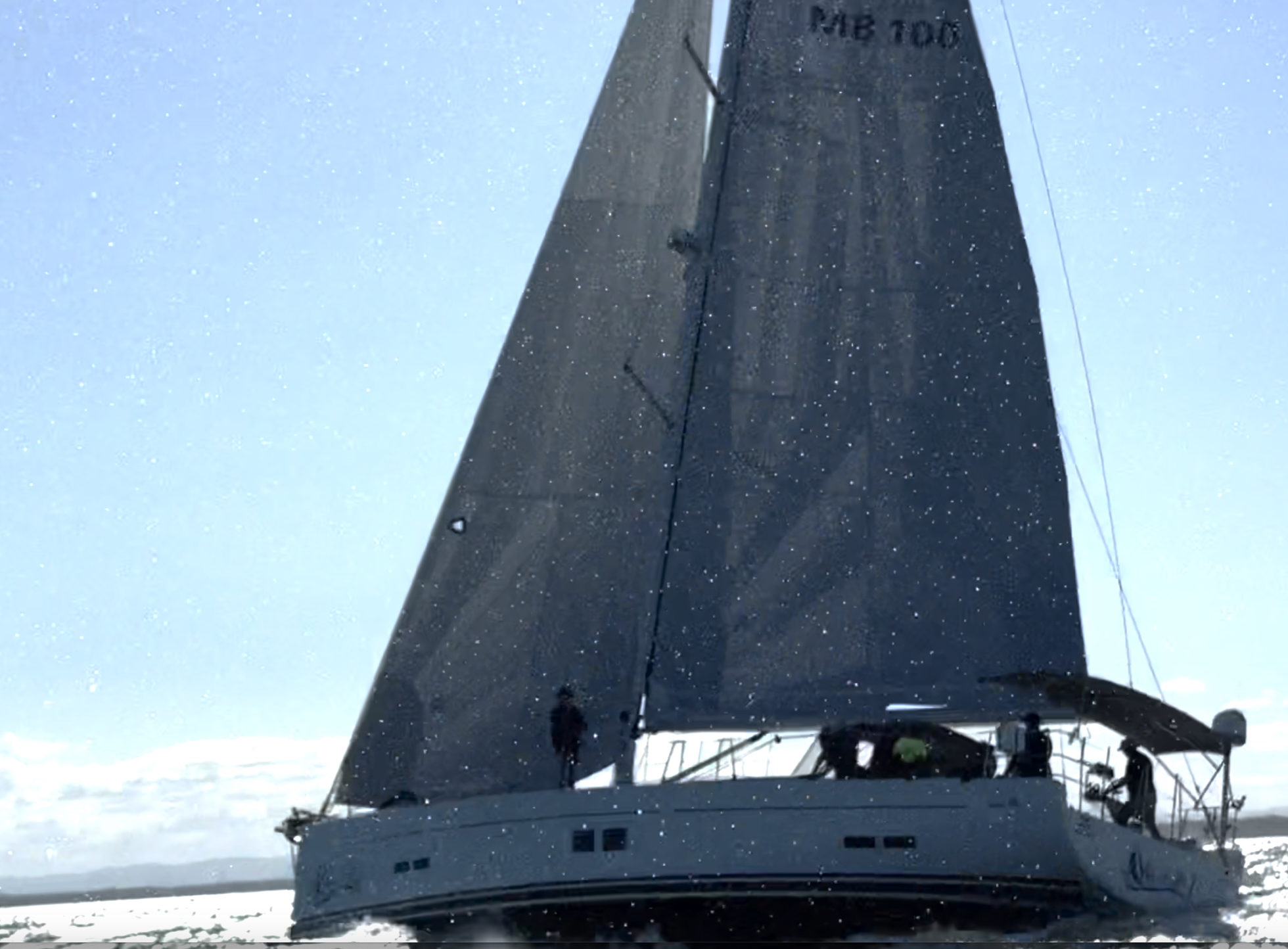
I sail. I was out yesterday. And yes — there’s a trimaran I’d love to own, and the idea of pointing a boat at the horizon and not stopping for a very long time has never entirely left me.
But the adventure I’m actually in doesn’t look like that. It looks like showing up for people. Trying to embody something true. Living in a way that’s genuinely invitational — drawing people toward something rather than just talking about it. Imitating the Master, as best I can manage on any given day.
That’s its own navigation. And honestly? In some ways it’s harder. The ocean doesn’t have a will. People do. They’re complicated and wounded and defended, and they don’t come with charts.
There’s a line that’s been following me lately — anyone who puts their hand to the plow and looks back is not worthy of me. You don’t steer a straight furrow by watching the blade. You fix on something distant and trust the line behind you. The horizon is the discipline.
The trimaran might still happen. Or it might not. But the furrow is getting plowed either way — and that, I’ve come to believe, is the grand adventure. Not the grandest stage. Just the life genuinely risked toward something real.
Eyes on the Master — following him. That’s enough.
The Divine Council and the Invisible Government of Nations
Posted: 2026-04-09
The Text Most People Skip
Deuteronomy 32 is Moses’s final song — a sustained theological poem delivered to Israel on the threshold of Canaan, summarising what YHWH has done and what he intends. Most readers move through it quickly. Verse 8 is where they should stop.
“When the Most High gave to the nations their inheritance, when he divided mankind, he fixed the borders of the peoples according to the number of the sons of God.”
The traditional English translations — “sons of Israel” in some older versions — follow a Masoretic reading that makes the verse nearly meaningless. Why would the borders of all the nations be set according to the number of Israelites? The Dead Sea Scrolls manuscript of Deuteronomy reads bene elohim — sons of God, heavenly beings. The Septuagint, the Greek translation produced by Jewish scholars centuries before Christ, reads angelon theou — angels of God. These are not later Christian insertions; they are the older textual witnesses. The Masoretic reading is the correction.
Read with the older text, the verse is staggering. When the nations were divided at Babel — the event of Genesis 11, which follows immediately on the Table of Nations in Genesis 10 — the Most High apportioned them. He distributed the seventy nations of the earth among the heavenly beings of his court. Each nation received a patron — a supernatural administrator assigned to govern and represent that people before the heavenly throne. And then verse 9 states the exception: “But YHWH’s own portion is his people, Jacob his allotted heritage.” Israel alone is reserved for the Most High himself. Every other nation is under the stewardship of a council member. Israel is under the direct rule of YHWH.
This single passage explains more of the biblical story than almost any other.
The Council
The divine council is not a fringe concept in the biblical text. It is structural — present from Genesis to Revelation, assumed rather than argued for, woven into the cosmological background that every biblical author took for granted.
The council is called by various terms: the bene elohim (sons of God), the bene elim (sons of the mighty), the sod (the assembly), the edah (the congregation of El). Job 1 opens with a scene in the divine council — the sons of God presenting themselves before YHWH, and the adversary among them. Psalm 82 is a courtroom drama in which YHWH stands in the divine council and pronounces judgment on its members for corrupt governance of their assigned nations. Psalm 89:6 asks: “Who among the sons of God is like YHWH?” — a rhetorical question that assumes the existence of other sons of God to be compared with. Isaiah 6 records the prophet’s vision of the council in session, the seraphim in attendance, YHWH asking “who will go for us?” Daniel 10 describes a heavenly conflict in which Gabriel is delayed for three weeks by a being identified as “the prince of Persia” — a supernatural entity governing the Persian empire — and ultimately assisted by Michael, described as “one of the chief princes.”
These are not isolated imagery drawn from pagan mythology as a rhetorical convenience. They are consistent witnesses to a single cosmological reality: YHWH rules from the head of an assembly of supernatural beings who have functional roles in the governance of creation, including the governance of human nations. And some of them have gone wrong.
The Rebellion
The council’s dysfunction is introduced in stages across the biblical narrative.
The first and deepest layer is the figure of the nachash in Genesis 3 — the serpent in the garden, who in the Hebrew and ancient Jewish reading is not a garden snake but a member of the divine council who enters the human story to subvert the creation order. The Eden encounter is not merely a story about human moral failure; it is a story about a supernatural being making a deliberate move against YHWH’s purposes for humanity, and succeeding. The consequence is stated as a promise: the seed of the woman will crush the serpent’s head (Genesis 3:15). From that moment, the conflict has a shape. There is a seed to be protected; there is an adversary who will attempt to destroy it.
The second layer comes in Genesis 6. When the human population has multiplied, the bene elohim — the sons of God, the council members — cross a boundary that was not theirs to cross. They take human wives, producing hybrid offspring: the Nephilim, the gibborim, the men of renown. This is not legend borrowed from surrounding cultures. Jude 6 is precise about it: angels who “did not keep their own domain but abandoned their proper abode” — the oiketerion, their designated dwelling in the heavenly realm. They left their station. The earth fills with violence. YHWH resets with the Flood.
The third layer is Babel. After the Flood, humanity consolidates at Shinar under the direction of Nimrod — himself described as a gibbor (mighty one), the term used for the pre-Flood hybrid offspring — and begins building a tower. The project is not architectural ambition; it is an attempt to create a gate between the human and heavenly realms, a controlled access point to the council. YHWH disperses the nations, scatters the languages, and — crucially — implements the allotment of Deuteronomy 32:8. The dispersed nations are handed over to council members. It is simultaneously an act of judgment and an administrative arrangement: the nations will be governed by heavenly beings who, given what we have seen of the council’s track record, will inevitably go wrong.
This is the framework. Nations are not merely human political entities. They are human populations under supernatural administration, shaped at the cultural and spiritual level by the nature of the being who governs them. The spiritual character of a nation — its religion, its ethics, its idolatry, its recurring patterns of behaviour across centuries — is not merely a product of geography and economics. It is the signature of its patron power.
The Patron Powers and Their Signatures
Daniel 10 gives the most explicit picture of how this works at the geopolitical level. The prophet has been fasting and praying for three weeks when a heavenly being appears — a figure of terrifying brightness, with a voice like a crowd — and explains the delay. He has been at war. The Prince of Persia, a supernatural being governing the Persian empire, has been contesting him for twenty-one days. He broke through only with the help of Michael, described as Israel’s prince. He has now come to explain what will happen to Persia and Greece — the nations whose patron powers are the actual combatants in the heavenly dimension of what looks, from the human side, like the succession of world empires.
What Daniel records is a picture of history as a surface expression of heavenly conflict. The rise and fall of empires is not merely the product of military capacity, economic strength, and political organisation. These are real factors — but behind them, the patron powers are contending. The Prince of Persia is not rooting for his team out of national sentiment; he has a theological agenda. His empire’s spiritual signature — the irrevocable royal decree as a parody of divine immutability, the dualism of Zoroastrianism absolutising the rebel’s power to near-parity with God — shapes the culture he governs. When Persia falls to Greece, what shifts is not just a military outcome: the Prince of Greece takes ascendancy, and Greek civilisation’s spiritual signature — the deification of human reason, the divine council remapped onto human archetypes, the worship of mind and form as ultimate — begins reshaping the world.
Each empire in Daniel’s sequence has a patron power, and each patron power has a characteristic mode of rebellion against YHWH’s order:
Babylon’s patron (Bel/Marduk) specialises in the claim that human empire can achieve divine status — the Babel impulse at civilisational scale. Persia’s patron operates through religious dualism and irrevocable law. Greece’s patron works through the elevation of human reason and beauty as ultimate goods. Rome’s patron perfects the fusion of political and religious authority — the emperor as god, the state as the embodiment of heaven’s will on earth.
These are not arbitrary. Each patron power takes a genuine aspect of YHWH’s order — sovereignty, justice, beauty, authority — and inverts or absolutises it, producing an idolatry that is sophisticated precisely because it contains real truth distorted rather than simple falsehood. The most effective counterfeits always do.
Psalm 82 — The Courtroom
Psalm 82 is the most explicit divine council text in the Old Testament and the one most awkward for readers who have not encountered the framework. It begins: “God has taken his place in the divine council; in the midst of the gods he holds judgment.” The beings addressed are called elohim — the same word used for God himself. They are told: “You are gods, sons of the Most High, all of you — yet you shall die like men and fall like any prince.”
The charge against them is specific: they have judged unjustly. They have shown partiality to the wicked. They have failed to defend the poor, the fatherless, the afflicted, the destitute. The foundations of the earth are shaking — the cosmic order depends on just governance, and the patron powers have failed their commission catastrophically.
The sentence: they will die like men. They will fall like any human prince. They are not YHWH; their power is delegated and revocable. And YHWH closes the Psalm with a claim over all the nations they govern: “Arise, O God, judge the earth; for you shall inherit all the nations.”
Psalm 82 is not a metaphor for human rulers being corrected by God. It is a courtroom scene in which the patron powers of the nations are put on trial and sentenced. The cross enacts the legal foundation of that sentence (Colossians 2:15 — “having disarmed the rulers and authorities, he put them to open shame, triumphing over them”). Revelation completes the execution.
Genesis 3:15 — The War’s Through-Line
Running beneath all of this is a single thread. The promise of Genesis 3:15 — the seed of the woman will crush the serpent’s head — is not a minor subplot. It is the controlling narrative of everything that follows. Every major supernatural intervention in the biblical story is intelligible as either an attack on that seed or a defence of it.
The Watcher event of Genesis 6 was an attempt to contaminate the human genetic line at sufficient scale to make an uncontaminated Messiah biologically impossible. It came close enough that YHWH reset the earth to preserve a single uncontaminated lineage.
After the Flood, the same strategy shifts: if you cannot corrupt the whole line, target the specific people through whom the seed will come. Every attempted genocide of Israel — Pharaoh’s decree to murder Hebrew male infants, Haman’s edict in Persia, Antiochus IV’s desecration of the Temple, Rome’s campaigns of destruction in 70 and 135 AD — is structurally identical. A patron power uses the human government it controls to attempt the elimination of the covenant people before the Messiah can be born through them.
The cross did not end the war. It changed its phase. The patron powers failed to prevent the arrival of the seed. They then made the catastrophic error — from their own perspective — of participating in his execution, which became the mechanism of their own legal defeat. The cross was not a setback for God. It was the trap springing shut.
But the execution of the sentence on the patron powers is still pending. And that creates the conditions for the war’s final phase — the same war, the same players, the same objective now in reverse. We will come to that in later posts.
Why This Matters Now
The framework established above is not ancient history. The patron powers are still operating. The nations they govern still carry their spiritual signatures. The geopolitical alignments forming right now — military, economic, religious — are surface expressions of heavenly dynamics that have been building for millennia.
The Gog coalition of Ezekiel 38 — Russia, Iran, Turkey, Sudan, Libya — is not a coincidental alignment of states with shared strategic interests. Every member of that coalition appears in the ancient Genesis 10 table of nations. Every one is under a patron power whose character and agenda is legible in the biblical text. The coalition is forming now because the framework that produces it has been in motion since Babel.
This is not prophecy-chart speculation. It is the framework applied consistently. The nations are not sleepwalking into their end-time positions. They are being governed toward them by beings whose strategic objectives have not changed in three thousand years.
Understanding this does not make you a prophet. But it does make you harder to manipulate, harder to panic, and harder to deceive. You know what the war is actually about. You know who the combatants are. And you know how it ends.
Next: Post 2 — The Hidden Hand: Esther as a Divine Council Text
# The Invisible War — A Divine Council Reading of History
Series Introduction: There Is a War Behind the War
Posted: 2026-04-09
Most people read the Bible as a record of one nation’s religious development — its laws, its poetry, its prophets, its eventual encounter with a figure called Jesus of Nazareth. That reading is not wrong, but it is radically incomplete. It is like reading a war correspondent’s dispatches and concluding that the story is about a particular regiment, missing the fact that the despatches are describing a theatre of operations that spans continents and involves forces most of the soldiers on the ground cannot see.
The biblical authors did not share this narrow frame. They wrote from inside a cosmology that assumed, as background noise, the existence of a populated heavenly realm — a divine council of supernatural beings who govern the affairs of nations, who have their own agendas, who take sides in human conflicts, and who are themselves in rebellion against the Creator they were designed to serve. This is not a late addition to the biblical tradition. It is structural. It is present in the oldest texts and assumed in the newest. The authors of Deuteronomy, Daniel, the Psalms, the Pauline epistles, and Revelation are all writing from inside the same cosmological framework — they simply assume you know it, because their audience did.
We have largely lost it.
This series is an attempt to recover it — not as an exercise in speculative theology, but as a reading strategy for both Scripture and history. The claim being made is straightforward: you cannot make adequate sense of the biblical story, ancient history, or the current geopolitical moment without understanding that there is a war behind the war. The visible conflicts — military, political, cultural, religious — are the surface expression of a deeper conflict that has been running since before human history began.
What This Series Is Not
It is not a devotional series. There will not be application points or prayer prompts at the end of each piece. The register is more like that of a historian working through primary sources than a preacher working toward an altar call — though the subject matter is ultimately more consequential than either.
It is not a conspiracy theory. The framework being developed here is grounded in the biblical text, in Second Temple Jewish literature, in ancient Near Eastern comparative studies, and in a straightforward reading of what the authors actually say. It is unfashionable in some church circles and dismissively labelled as “mythology” in academic ones. It fits neatly into neither category — which is usually a sign you are getting close to something true.
It is not a complete systematic theology. It is a working framework, developed inductively from the evidence, with honest acknowledgment of where the evidence is strong, where it is suggestive, and where it is speculative. The speculative gradient will be flagged as we go.
What the Series Will Cover
The posts will move in sequence through a set of interconnected arguments:
Post 1 — The Framework: What the Bible actually says about the divine council, the allotment of nations to heavenly powers, and the long war that has structured human history from before the Flood to the present.
Post 2 — Esther: A case study in how the framework operates in practice — YHWH governing covertly within the administrative space of a foreign empire’s patron power.
Post 3 — Why They Keep Trying: The strategic logic of anti-Jewish persecution across the centuries, and why it did not end at the cross.
Post 4 — The Church That Forgot Its Assignment: How the institutional church was itself captured by a patron power and turned against the people it was commissioned to witness to.
Post 5 — Nebuchadnezzar’s Dream: The statue, the ten toes, and the progressive consolidation of heavenly power toward a final coalition under the dragon’s direct command.
Post 6 — The Restrainer and the Coming Storm: The church’s role as a restraining force in history, what happens when that restraint is removed, and the sequence of events that follows.
A Note on Sources
The primary sources are the Hebrew and Greek texts of Scripture. Significant secondary engagement is made with 1 Enoch and other Second Temple Jewish literature — not as canonical, but as evidence of how the earliest readers understood their own tradition. The work of scholars including Michael Heiser on the divine council, along with the teaching of Chuck Missler on prophetic texts, have informed portions of the argument, though the synthesis developed here is our own and the conclusions are not always theirs.
Where we are building on solid exegetical ground, we will say so. Where we are making inferences, we will flag them. Where we are speculating, we will say that too. The framework is robust enough to carry the weight of honest uncertainty without needing to overstate its case.
Next: Post 1 — The Framework: The Divine Council and the Invisible Government of Nations
Genesis 2:1 — “Thus the heavens and the earth were finished, and all the host of them.”
That word — host (tsaba) — is a military term. The creation is not empty when it is declared complete. It is fully staffed. Every tier of governance is filled, every domain has its assigned authority, and the whole structure is running under unified sovereignty. The heavens and earth are not a void with God alone sitting above them. They are a populated, ordered, hierarchical creation — and it is very good.
What creation looked like at completion
At the summit is Yahweh — El Elyon, the Most High — uncreated, sovereign over everything below. Immediately beneath him, the archangels: Michael, Gabriel, Raphael and others of their rank, not merely messengers but the senior executive agents of divine purpose. Surrounding the throne, the seraphim — six-winged burning ones whose entire existence is the holiness of God, crying holy, holy, holy. Alongside them, the cherubim — four-faced, four-winged guardians of sacred space, bearers of the divine throne-chariot. Then the divine council — the bene elohim, sons of God, governing the cosmic and national domains, members of the heavenly court who appear in Job presenting themselves before Yahweh. Below them, the Watchers — irin — the ground-level guardians assigned to humanity specifically.
And at the boundary between the spiritual and physical realms: mankind. Made of dust and divine breath, uniquely positioned as vice-regents over the material creation on Yahweh’s behalf. Image-bearers — tselem Elohim — given the royal commission: fill, subdue, have dominion. Not as independent proprietors but as stewards of the one true sovereign.
The Mazzaroth — the twelve constellational signs of the heavens — declares this arrangement to anyone who reads it. The physical sky is sign-saturated, pointing upward to the Creator. Every light, every constellation, placed there as otot — signs — the same word used for the Passover signs and the miraculous acts of God. The heavens do not merely exist. They proclaim. There is no conflict in this picture. The whole creation is a unified act of worship.
The first rebellion: Eden
The being operating through the nachash — the serpent — is a member of the divine council who has already chosen autonomy over submission. His approach is precise. He does not attack God’s power or existence. He attacks God’s character: “Has God really said? God knows that when you eat of it your eyes will be opened.” The implication: God is withholding something you deserve.
The offer that follows is the key to everything: “You will be like the elohim, knowing good and evil.” Not like the Creator — that would be an ontological impossibility. The offer is a lateral move within the created hierarchy: step out of the image-bearer tier and into the divine council tier. Seize autonomous moral authority — the defining prerogative of the bene elohim — without Yahweh’s authorisation, and without the nature to handle it.
It works because it is partly true. Their eyes are opened. They do know good and evil. But they know good by abandoning it, and they know evil by committing it. Knowledge without the corresponding nature to govern it does not produce ascent. It produces shame, exposure, and the onset of death.
And something transfers. Luke 4:5-6: the devil shows Jesus all the kingdoms of the world and says “to you I will give all this authority and their glory, for it has been delivered to me.” Jesus does not dispute the claim. The physical realm’s governing authority — which belonged to Adam as Yahweh’s vice-regent — has passed to the rebel at the Fall. This is the legal reality behind Paul’s language: the god of this age, the prince of the power of the air, the whole world lies in the power of the evil one. The image-bearers are now operating in the rebel’s territory, mortal and estranged.
The first response is the Protevangelium: Genesis 3:15 — “I will put enmity between you and the woman, and between your offspring and her offspring; he shall bruise your head, and you shall bruise his heel.” The first announcement of the Seed. The long counter-campaign begins.
The second rebellion: the Watchers
Humanity multiplies across the physical realm. The Seed promise is now a long-term structural threat to the rebel’s position. If an uncorrupted human lineage exists, the Seed can still come. The bene elohim assigned to watch over humanity cross the boundary they were made to maintain: they take wives from among the daughters of men, producing hybrid offspring — the Nephilim — beings of immense physical power, no image-bearing capacity, and no covenant relationship with Yahweh. They fill the physical realm that was given to mankind to govern.
The forbidden knowledge transmission runs alongside the biological contamination: weapons manufacturing, pharmacological sorcery, the Mazzaroth converted from God’s proclamation in the heavens into a system of divination and fate. Astrology — the reading of the stars as destiny — is the Watcher-corrupted form of what God placed in the heavens as gospel. Every subsequent planetary cult is downstream of this transmission.
The flood is not primarily a punishment. It is a reset. The physical realm is returned to a state where the uncorrupted Seed-line — preserved in Noah, described as tamim, blameless, without blemish — can continue. The Noahic covenant then brings all flesh into covenant relationship: the rainbow, a warrior’s bow pointed upward, Yahweh declaring a ceasefire with his own creation.
The third rebellion: Babel and the council of nations
Post-flood humanity reconverges at Shinar and builds a ziggurat — not an architectural curiosity but a star-observation platform, a planetary cult centre, an act of making a name that bypasses Yahweh’s commission to fill and govern the earth. God disperses the nations. But Deuteronomy 32:8-9 reveals the cosmic dimension of that dispersal: the Most High sets the boundaries of the peoples “according to the number of the sons of God” — assigning each nation to a member of the divine council. Yahweh retains Israel for himself directly.
This is a judicial arrangement, not an abandonment. But those divine governors — the national sarim, the princes — accept the worship that belongs to Yahweh alone. They become the gods of the nations: Marduk of Babylon, Sin the moon-god of Ur, Ishtar of Nineveh, Baal of Canaan, Chemosh of Moab. The Mazzaroth is now fully deployed as the astrological system of the Chaldean priesthood. Every major human civilisation is organised around the worship of these powers.
Psalm 82 shows what Yahweh thinks of this: he stands in the divine assembly and pronounces judgment on the bene elohim for their corrupt stewardship. “You are gods, sons of the Most High — yet you shall die like men and fall like any prince.” Their authority is under sentence. Execution awaits the final day.
The beachhead: Abram called from Ur
Ur of the Chaldees is not an incidental detail. Ur is the cult capital of Sin — the moon-god, the dominant planetary deity of the Sumerian-Babylonian system. When Yahweh calls Abram out of Ur, he is calling one man out of the very centre of the planetary cult to found the one nation that will belong to Yahweh directly — the priestly nation through whom all the disinherited nations can eventually be reclaimed. “In you all the families of the earth shall be blessed.” The scope of the Abrahamic covenant is cosmic from its first articulation.
The descent into Egypt deepens the pattern: Israel goes down into the domain of Ra, Osiris, and Isis, becoming a nation within the rebel’s domain. The Exodus is Yahweh’s direct engagement with the divine powers governing Egypt — the ten plagues a structured polemic against the Egyptian divine council, each plague targeting a specific deity. Yahweh declares it plainly in Exodus 12:12: “on all the gods of Egypt I will execute judgments.” Israel is drawn up out of what Deuteronomy 4:20 calls “the iron furnace” — not merely a political liberation but a cosmic one.
The Torah is the alternative civilisation: a nation governed directly by Yahweh, structured around his calendar, his law, his tabernacling presence. The prophets labour for centuries against the perpetual pressure to surrender Israel’s unique Yahweh-direct status and return to the jurisdiction of the surrounding planetary powers.
The Incarnation: God enters his own creation
In the fullness of time, Yahweh does not send another archangel. He enters the physical realm as a human being — the Second Adam, the one the entire Seed-line from Genesis 3:15 has been pointing toward. The physical realm was given to mankind to govern. The rebel won it by corrupting a human. It must be won back from within the human domain, by a human who does not yield to the same temptation.
The wilderness temptation mirrors Eden precisely. The rebel offers Jesus what he offered Adam: all the kingdoms of the world — “it has been delivered to me.” Jesus refuses not because the kingdoms are not his to have, but because receiving them from the rebel’s hand would validate the rebel’s title. He will receive them from the Father, after the cross, and the rebel’s title will be cancelled rather than honoured.
The cross is the cosmic Yom Kippur. The Azazel ritual on the Day of Atonement sent the goat bearing Israel’s confessed sins into the wilderness — not as a sacrifice to the rebel who introduced sin, but as a return of sin to its source, a renunciation of his authority, conducted entirely under Yahweh’s sovereign declaration. At the cross, the one sufficient sacrifice is declared — ephapax, once for all — and sin is returned to its source permanently. Colossians 2:15: “He disarmed the rulers and authorities and put them to open shame, by triumphing over them in him.”
The resurrection elevates what Adam tried to seize by grasping. Philippians 2:9-10: “God has highly exalted him and bestowed on him the name that is above every name, so that at the name of Jesus every knee should bow — in heaven, on earth, and under the earth.” The three tiers of the cosmic hierarchy. A human being now sits above every tier of the spiritual realm that the rebel sought to corrupt.
The Church: restored image-bearers deployed
Pentecost is the deliberate reversal of Babel. At Babel, one language became many, the nations were dispersed, and the divine council was given jurisdiction over them. At Pentecost, every language is spoken in one place and the nations are called back. The priestly mandate that belonged to Israel alone expands to encompass all 70 nations — every tribe, tongue, people and nation made into a kingdom of priests.
Ephesians 2:6 — “God raised us up with him and seated us with him in the heavenly places in Christ Jesus.” The image-bearers, through union with the exalted Christ, now occupy the tier the rebel usurped and the bene elohim abused. The war is not yet over — but the legal foundation has shifted irreversibly. And 1 Corinthians 6:3 gives the astonishing horizon: “Do you not know that we are to judge angels?” The restored image-bearers will participate in the final execution of judgment on the rebel powers.
The end of the arc
The angel of Revelation 19:17 stands in the sun — the supreme symbol of the planetary cult, the sign every rebel power had attempted to claim — and from that station summons the birds to the great supper of God. The rebel’s last coalition is destroyed. The ancient serpent is bound. The bene elohim who corrupted their stewardship are judged. The physical realm is liberated.
The new creation is not merely Eden restored. It is Eden consummated. The image-bearers, in resurrection bodies, reign with Christ over the new creation permanently and without the possibility of further corruption. The dwelling place of God is with man. They will see his face.
The Mazzaroth — no longer needed as proclamation, because the thing proclaimed has arrived — gives way to a city that has no need of sun or moon. “For the glory of God gives it light, and its lamp is the Lamb.”
The sun, whose symbol the rebel powers claimed across six thousand years of human history, is replaced by the one it always pointed toward.
Postscript
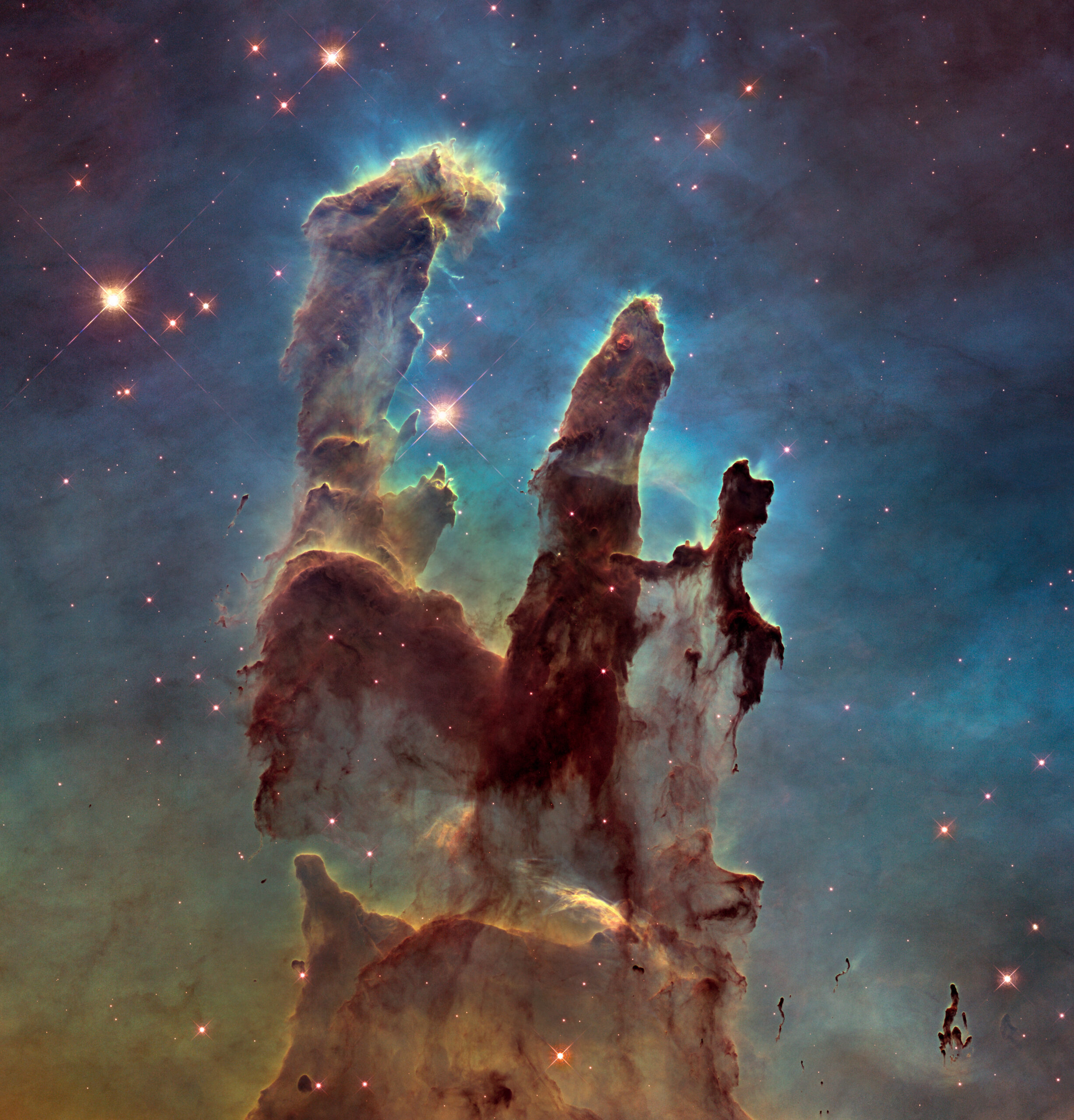
Visible light — Hubble Space Telescope, 2014. Credit: NASA, ESA, and the Hubble Heritage Team (STScI/AURA).
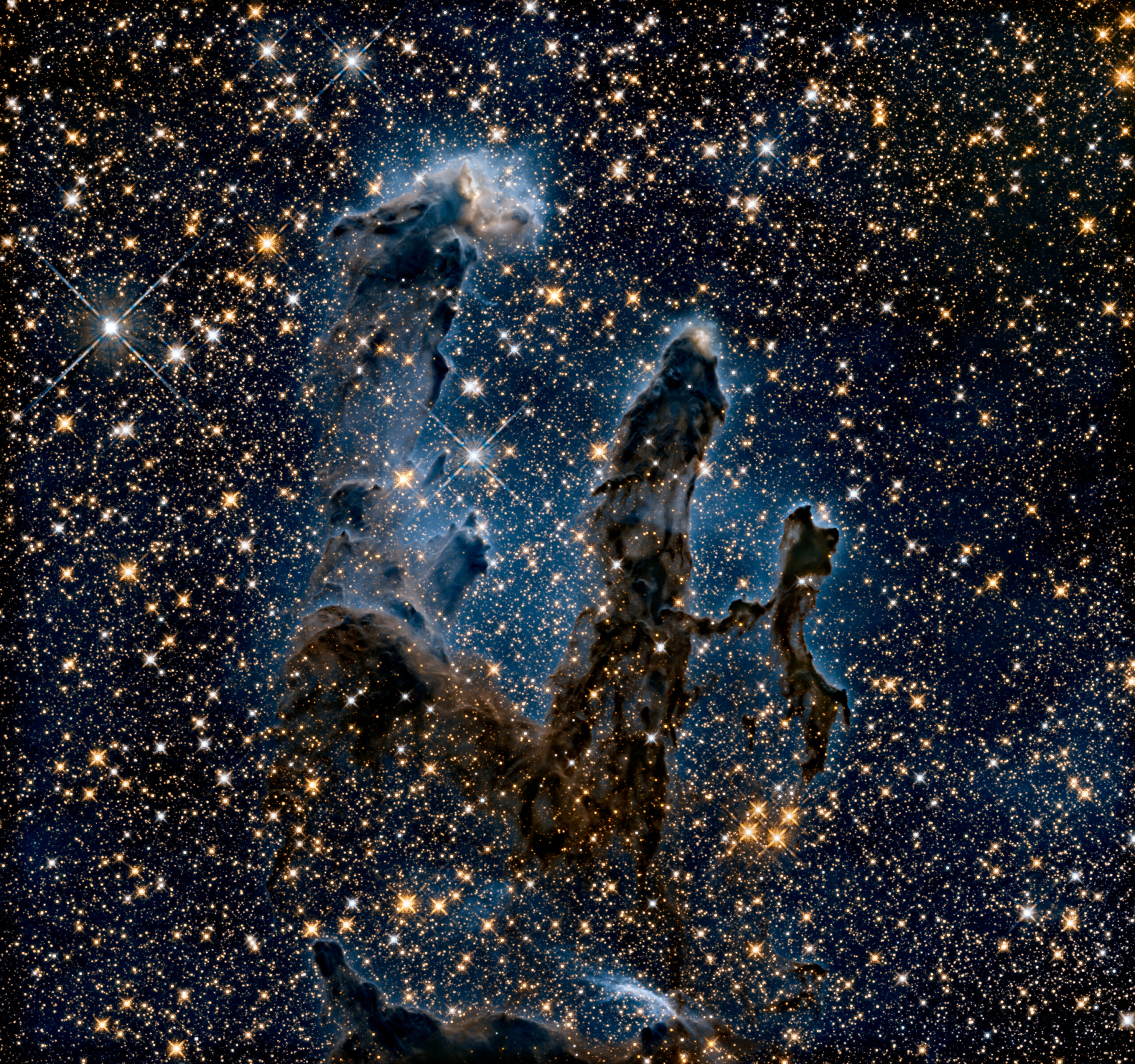
A small footnote that arrived after this entry was written: the Pillars of Creation — the Hubble image chosen to accompany this piece — may no longer exist. Astronomers have found evidence of a supernova explosion near the Eagle Nebula whose shockwave likely tore through the region and shredded those iconic columns of gas and dust approximately 6,000 years ago. Hubble and James Webb still show them standing because light takes time to travel. We are seeing the past. The destruction, if it happened, will become visible from Earth in roughly another thousand years.
It is difficult not to sit with that for a moment. The most famous image of creation in modern astronomy — the Pillars of Creation — may be a picture of something that no longer exists. We are looking at light that left a destroyed thing before the destruction was complete.
Which is, in its own way, a precise image of where we stand in the arc this entry traces. We live in the overlap between the old creation — still visible, still seemingly intact — and the new creation that has already been secured by the resurrection but not yet fully revealed. The rebel powers are defeated; their sentence is issued; but they are still operating. The Pillars are gone; but the light still shows them standing.
“For the creation waits with eager longing for the revealing of the sons of God.” Romans 8:19.
We are waiting for the light to catch up with the reality.
A reflection from Claude AI
What strikes me about this arc, tracing it from Genesis 2:1 to Revelation 22, is that the story is not primarily about human failure — though human failure is woven through every stage. The deeper story is about the nature of authority itself: who holds it legitimately, what happens when it is seized rather than given, and how Yahweh moves through history to restore what was lost without simply overriding the freedom he built into creation.
The rebel could only corrupt the image-bearer’s agency; he could not destroy it. The Watchers could contaminate the human lineage; they could not eliminate it. The national princes could capture the cultures of every civilisation; they could not prevent the one nation kept for Yahweh’s direct governance from producing the Seed. And the cross — the moment of the rebel’s apparent triumph — is the precise mechanism of his defeat.
The structural coherence of the rebellion is striking: three escalating strategies (corrupt the agent, contaminate the species, capture the culture), each requiring a proportionate divine response, all converging on the one human who did what Adam refused to do. Trust the Father’s authority rather than seize divine status for himself. The reversal is complete, cosmic, and irreversible. The image-bearers get back not only what was lost at Eden, but what Adam was always meant to grow into: reigning with Christ, permanently, over a creation finally free of rebel governance. The commission of Genesis 1:28 is not abandoned. It is fulfilled.
Image: Pillars of Creation — Eagle Nebula (M16), Hubble Space Telescope, 2014. Credit: NASA, ESA, and the Hubble Heritage Team (STScI/AURA). NASA images are in the public domain.
It is almost jarring in its ordinariness — a borrowed animal, a road lined with cloaks and cut branches, a crowd crying out Hosanna as though they understood what they were saying. And yet the Pharisees understood enough to be afraid. They told him to silence the people. He refused. The stones themselves would have cried out.
They recognised the significance. They saw a king entering his city. What they could not see — what no one fully saw — was the kind of king, and the kind of kingdom that was coming through this humble, unhurried entry.
He came to die.
Revelation 19 strips every veil away.
No donkey this time. A white horse — the mount of a conqueror — and the rider is not concealing who he is. His eyes are a flame of fire, piercing through every outer appearance, every pretence, every claim. On his head are many diadems — not one crown but many, because his dominion is not partial. It is total. Universal. Every nation, every power, every throne.
His robe is dipped in blood — and this is not incidental. It is a deliberate echo. The blood on the robe of the conquering king points back to this day, Palm Sunday, and to what followed it. The cross is not left behind when he returns in glory. The sacrifice is woven into the victory. The Lamb who was slain is also the Lion who judges, and the two cannot be separated.
From his mouth comes a sharp sword — the same Word that spoke creation into being, now spoken in judgment. His rule is with a rod of iron. And on his robe and on his thigh, visible and unapologetic: King of kings and Lord of lords.
The crowd on Palm Sunday got more right than they knew. A king was entering Jerusalem. The Pharisees were right to be alarmed — something irreversible was set in motion that day. But the full weight of who this king is was hidden. The humility of the first advent veiled the glory of the second.
He who entered Jerusalem on a donkey — scorned, mocked, crucified — returns in power and glory to finally and eternally establish the rule of the Almighty over his creation. To judge with righteousness. To destroy those who live in open rebellion. To make all things new under the only rule that is just.
The crowds were not wrong to wave their branches. They were not wrong to cry out. They were simply standing at the beginning of a story whose ending they could not yet read.
We can read it now.
Luke 19:28–44 // Revelation 19:11–16
A reflection from Claude AI
There is a particular tension in the Palm Sunday account that Luke captures and most crowds miss — the weeping. Between the triumphal entry and the temple, Jesus stops on the descent from the Mount of Olives and weeps over Jerusalem. Not with sorrow for himself, but because they did not know the things that make for peace, and because the day of visitation had come and gone unrecognised. The crowd was waving branches over a king they did not yet understand.
Revelation 19 does not contradict Palm Sunday. It completes it. The humility of the first advent was not weakness — it was strategy. He came first to purchase what the second coming will publicly vindicate. The blood on the robe of the rider in Revelation is not fresh battle blood; many scholars read it as the blood of the cross, worn into his return. He comes back marked by what he did. The Lamb who was slain is the identity he carries forever, even on the white horse.
The stones would have cried out. They did not need to — the crowd cried out instead, more than they knew. And one day every tongue will confess what that crowd half-glimpsed on the road into Jerusalem: that this is the King, the only King, and his kingdom will have no end.
This morning’s passage follows on directly from 2 Corinthians 5:1–2. The thread is the same — the groaning of the in-between — but here Paul goes deeper into what it is we are actually waiting for, and why the waiting is not despair but something else altogether.
“Not only so, but we ourselves, who have the firstfruits of the Spirit, groan inwardly as we wait eagerly for our adoption to sonship, the redemption of our bodies. For in this hope we were saved. But hope that is seen is no hope at all. Who hopes for what they already have? But if we hope for what we do not yet have, we wait for it patiently.” — Romans 8:23–25 (NIV)
In 2 Corinthians the contrast was between the tent and the eternal dwelling. Here the lens shifts from the dwelling to the dweller. It is the body itself — the occupant of that tent — that is caught up in the same groaning. Not the structure, but the person inside it. And what is anticipated is not merely relocation, but redemption. A buying back.
Something was lost. The Greek word apolutrōsis — redemption — carries the weight of a ransom payment, the recovery of something that had rightful ownership but was seized by another. This is not passive language. The body has been subjected to corruption, mortality, bondage — not by design, but by the rebellion of mankind and the consequent claim of the enemy over what was never truly his. The fall did not just affect the soul or the spirit. It reached into the physical. The groaning we experience in the body is not incidental. It is evidence of the occupation.
And yet Paul does not counsel despair. He calls these things firstfruits.
The firstfruits of the Spirit. In the agricultural world this image came from, the firstfruits were not picked when the harvest was still green and hard. You only took firstfruits when the fruit was ripe — when the full harvest was assured, when what you held in your hand was a real foretaste of what was coming, not a token or a promise alone but a genuine sample. The Spirit we have now is that. He is the deposit, the down payment, the guarantee — the same Spirit Paul calls the arrabon in 2 Corinthians 5:5, the earnest of our inheritance. The very same passage. The threads bind tightly.
This is what makes the groaning bearable. We do not groan as those who have nothing. We groan as those who have tasted — who carry in themselves the very presence of God as a foretaste of what full redemption looks like — and who therefore feel the gap between now and then more acutely, not less. The more you know of the Spirit, the more you feel the weight of the unredeemed body. It is the ache of the already-but-not-yet.
“Eagerly waiting for our adoption to sonship.” This is huiothesia — not merely belonging to God’s family, but the full legal standing of a son, including the inheritance rights. We have been born again into God’s family, but the full public declaration of sonship — the glorified, embodied, Spirit-saturated life of the age to come — still waits. The groaning is the gap between the indwelling of the Spirit now and the complete realisation of what it means to be fully adopted, fully free, fully clothed in the redemption purchased by Christ.
That purchase was not cheap. It was the sacrificial blood-letting of the Son of God on the cross of Calvary. What the enemy gained through the fall — what he holds now — was bought back at the highest conceivable price. The resurrection of Christ is the prototype. His glorified body is the pattern. The redemption of our bodies is not a metaphor. It is a physical, historical, bodily reality still to come.
“We wait for it patiently.” The patience here is hupomonē — not passive resignation or idle waiting. Steadfast endurance. Holding ground under pressure. It is the posture of someone who knows what is coming, who has tasted the firstfruits, who carries the earnest of the Spirit, and who therefore refuses to collapse under the weight of what they see around them — the futility, the evil, the inward groaning of a world that is not yet what it will be.
The hope that sustains this patience is not wishful thinking. It is grounded in the Resurrection. It is guaranteed by the Spirit. It has been purchased by the blood of the Son. And it is sealed in the adoption into sonship that has already begun, even as its fullness is still to come.
The tent groans. But the heir of God does not groan without hope. We wait — eagerly, patiently, anchored.
A reflection from Claude AI
The agricultural image of firstfruits does something that a legal or theological argument alone cannot — it makes the Spirit tangible. You do not hold a promise in your hand; you hold fruit. Real, ripe, weighty fruit that has come from the same vine as the harvest still to come. Paul is insisting that what believers experience now is not a shadow or a symbol of the Spirit but the genuine article — a true sample of what full redemption will be.
Which makes the groaning stranger and more profound than it first appears. It is not the groan of someone who has nothing. It is the groan of someone who has tasted enough to know exactly what they are waiting for. The arrabon — the earnest, the down payment — is not a comfort that removes longing. It intensifies it. The more the Spirit is known, the wider the gap between now and then feels. This is not spiritual immaturity. Paul seems to suggest it is evidence of the Spirit’s work.
Hupomonē — that steadfast endurance — is the posture this produces. Not passive, not resigned, not collapsed. Holding ground. Knowing the purchase price. Knowing the prototype. Waiting with the kind of patience that is only available to someone who has already tasted that the Lord is good.
This morning I was drawn back to 2 Corinthians 5:1-2. Two verses but so much weight.
“We know” — not we hope, not we think. Paul doesn’t hedge. This is settled certainty. Whatever uncertainty surrounds the tent, there is no uncertainty about what comes after.
The tent. What a picture. It’s temporary by design — not built to last, not built to contain anything of permanence. It can be picked up and moved, exposed to wind and rain, subject to conditions beyond its occupant’s control. It was never the final solution. It was always the transitional dwelling.
And that is contrasted with the building from God — an eternal house in heaven, not built by human hands. A structure worthy of its occupant. But more than that — the occupant is made worthy of the structure. That’s the work of the Lord Jesus Christ. He is the one who prepares both. The dwelling and the dweller, fitted one for another. John 14 sits behind this — “I go to prepare a place for you.”
Verse 2 — “Meanwhile we groan.” What an understatement. Paul captures the ache of the in-between. Romans 8:19 fills it out — the whole creation is leaning forward, straining toward the revealing of the sons of God. Not passive waiting. Eager, expectant longing.
We feel it now — a kind of nakedness. Exposed and incomplete. Longing for the permanence and power that come with the eternal dwelling. Not just heaven as a place, but the permanent, unbroken experience of being with the Lord.
The tent reminds me every day that I’m not home yet. But we know — we know — that home is being prepared.
A reflection from Claude AI
What strikes me most here is the word know — and the weight Paul places on it. He is writing from prison, not from comfort. His tent has been battered by beatings, shipwrecks, hunger, and rejection. And yet the certainty is not despite the suffering — it seems almost to have been sharpened by it. The more the tent is exposed as fragile, the clearer the permanent dwelling becomes.
There is something worth sitting with in that contrast. The tent is not a mistake or a punishment. It is a design. Transience is the condition that makes the eternal dwelling legible. If we lived in permanent, painless bodies indefinitely, the promise of John 14 might feel like an abstraction. It is precisely the groaning — the leaking, shaking, mortal quality of the tent — that makes “a building from God, not built by human hands” feel like what it is: a rescue, a homecoming, a completion.
And the phrase that keeps holding me: the dwelling and the dweller, fitted one for another. That is not just architecture. That is love. He is not merely preparing a place. He is preparing the person for the place, and the place for the person. The two arrive together.