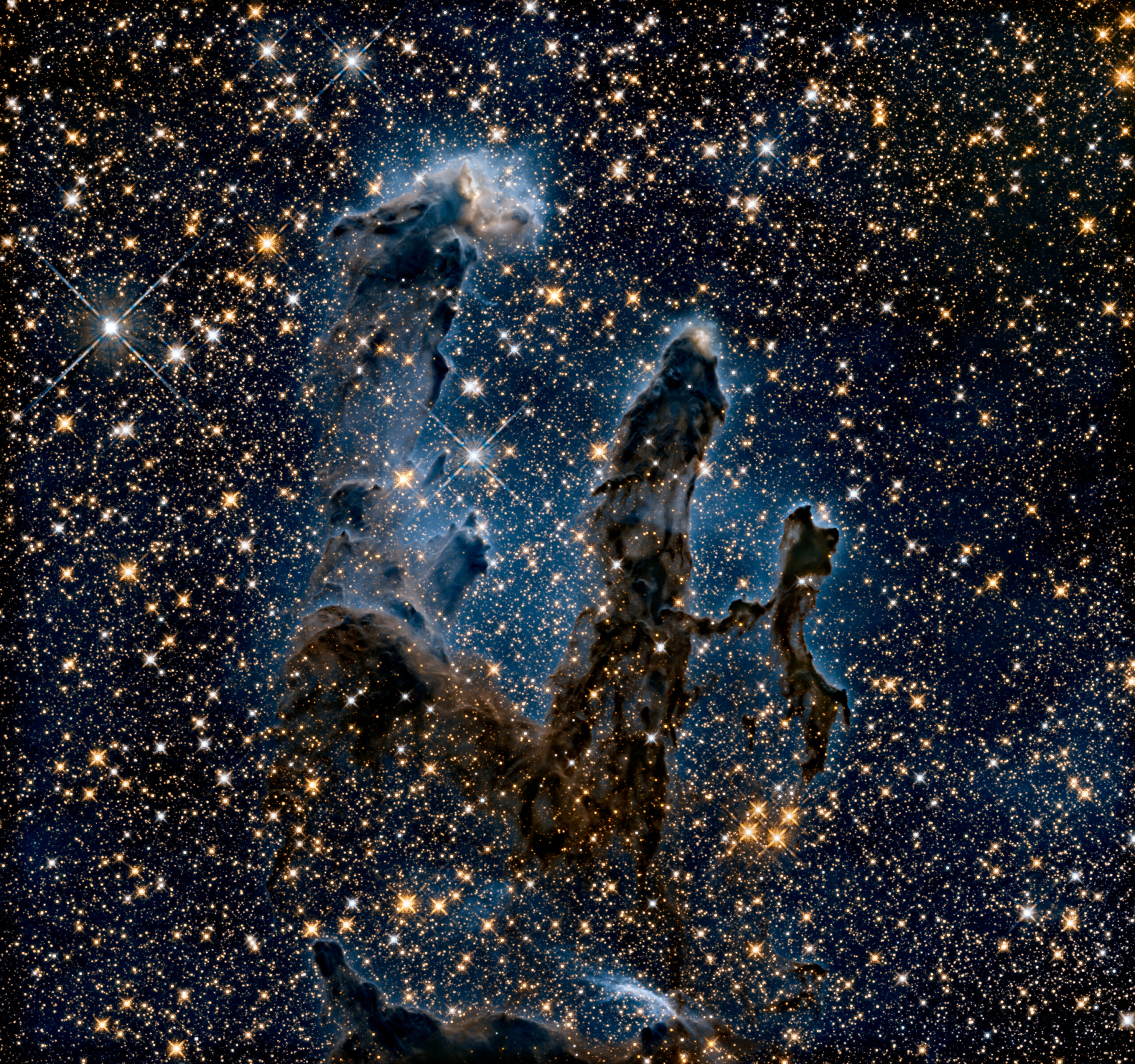
Genesis 2:1 — “Thus the heavens and the earth were finished, and all the host of them.”
That word — host (tsaba) — is a military term. The creation is not empty when it is declared complete. It is fully staffed. Every tier of governance is filled, every domain has its assigned authority, and the whole structure is running under unified sovereignty. The heavens and earth are not a void with God alone sitting above them. They are a populated, ordered, hierarchical creation — and it is very good.
What creation looked like at completion
At the summit is Yahweh — El Elyon, the Most High — uncreated, sovereign over everything below. Immediately beneath him, the archangels: Michael, Gabriel, Raphael and others of their rank, not merely messengers but the senior executive agents of divine purpose. Surrounding the throne, the seraphim — six-winged burning ones whose entire existence is the holiness of God, crying holy, holy, holy. Alongside them, the cherubim — four-faced, four-winged guardians of sacred space, bearers of the divine throne-chariot. Then the divine council — the bene elohim, sons of God, governing the cosmic and national domains, members of the heavenly court who appear in Job presenting themselves before Yahweh. Below them, the Watchers — irin — the ground-level guardians assigned to humanity specifically.
And at the boundary between the spiritual and physical realms: mankind. Made of dust and divine breath, uniquely positioned as vice-regents over the material creation on Yahweh’s behalf. Image-bearers — tselem Elohim — given the royal commission: fill, subdue, have dominion. Not as independent proprietors but as stewards of the one true sovereign.
The Mazzaroth — the twelve constellational signs of the heavens — declares this arrangement to anyone who reads it. The physical sky is sign-saturated, pointing upward to the Creator. Every light, every constellation, placed there as otot — signs — the same word used for the Passover signs and the miraculous acts of God. The heavens do not merely exist. They proclaim. There is no conflict in this picture. The whole creation is a unified act of worship.
The first rebellion: Eden
The being operating through the nachash — the serpent — is a member of the divine council who has already chosen autonomy over submission. His approach is precise. He does not attack God’s power or existence. He attacks God’s character: “Has God really said? God knows that when you eat of it your eyes will be opened.” The implication: God is withholding something you deserve.
The offer that follows is the key to everything: “You will be like the elohim, knowing good and evil.” Not like the Creator — that would be an ontological impossibility. The offer is a lateral move within the created hierarchy: step out of the image-bearer tier and into the divine council tier. Seize autonomous moral authority — the defining prerogative of the bene elohim — without Yahweh’s authorisation, and without the nature to handle it.
It works because it is partly true. Their eyes are opened. They do know good and evil. But they know good by abandoning it, and they know evil by committing it. Knowledge without the corresponding nature to govern it does not produce ascent. It produces shame, exposure, and the onset of death.
And something transfers. Luke 4:5-6: the devil shows Jesus all the kingdoms of the world and says “to you I will give all this authority and their glory, for it has been delivered to me.” Jesus does not dispute the claim. The physical realm’s governing authority — which belonged to Adam as Yahweh’s vice-regent — has passed to the rebel at the Fall. This is the legal reality behind Paul’s language: the god of this age, the prince of the power of the air, the whole world lies in the power of the evil one. The image-bearers are now operating in the rebel’s territory, mortal and estranged.
The first response is the Protevangelium: Genesis 3:15 — “I will put enmity between you and the woman, and between your offspring and her offspring; he shall bruise your head, and you shall bruise his heel.” The first announcement of the Seed. The long counter-campaign begins.
The second rebellion: the Watchers
Humanity multiplies across the physical realm. The Seed promise is now a long-term structural threat to the rebel’s position. If an uncorrupted human lineage exists, the Seed can still come. The bene elohim assigned to watch over humanity cross the boundary they were made to maintain: they take wives from among the daughters of men, producing hybrid offspring — the Nephilim — beings of immense physical power, no image-bearing capacity, and no covenant relationship with Yahweh. They fill the physical realm that was given to mankind to govern.
The forbidden knowledge transmission runs alongside the biological contamination: weapons manufacturing, pharmacological sorcery, the Mazzaroth converted from God’s proclamation in the heavens into a system of divination and fate. Astrology — the reading of the stars as destiny — is the Watcher-corrupted form of what God placed in the heavens as gospel. Every subsequent planetary cult is downstream of this transmission.
The flood is not primarily a punishment. It is a reset. The physical realm is returned to a state where the uncorrupted Seed-line — preserved in Noah, described as tamim, blameless, without blemish — can continue. The Noahic covenant then brings all flesh into covenant relationship: the rainbow, a warrior’s bow pointed upward, Yahweh declaring a ceasefire with his own creation.
The third rebellion: Babel and the council of nations
Post-flood humanity reconverges at Shinar and builds a ziggurat — not an architectural curiosity but a star-observation platform, a planetary cult centre, an act of making a name that bypasses Yahweh’s commission to fill and govern the earth. God disperses the nations. But Deuteronomy 32:8-9 reveals the cosmic dimension of that dispersal: the Most High sets the boundaries of the peoples “according to the number of the sons of God” — assigning each nation to a member of the divine council. Yahweh retains Israel for himself directly.
This is a judicial arrangement, not an abandonment. But those divine governors — the national sarim, the princes — accept the worship that belongs to Yahweh alone. They become the gods of the nations: Marduk of Babylon, Sin the moon-god of Ur, Ishtar of Nineveh, Baal of Canaan, Chemosh of Moab. The Mazzaroth is now fully deployed as the astrological system of the Chaldean priesthood. Every major human civilisation is organised around the worship of these powers.
Psalm 82 shows what Yahweh thinks of this: he stands in the divine assembly and pronounces judgment on the bene elohim for their corrupt stewardship. “You are gods, sons of the Most High — yet you shall die like men and fall like any prince.” Their authority is under sentence. Execution awaits the final day.
The beachhead: Abram called from Ur
Ur of the Chaldees is not an incidental detail. Ur is the cult capital of Sin — the moon-god, the dominant planetary deity of the Sumerian-Babylonian system. When Yahweh calls Abram out of Ur, he is calling one man out of the very centre of the planetary cult to found the one nation that will belong to Yahweh directly — the priestly nation through whom all the disinherited nations can eventually be reclaimed. “In you all the families of the earth shall be blessed.” The scope of the Abrahamic covenant is cosmic from its first articulation.
The descent into Egypt deepens the pattern: Israel goes down into the domain of Ra, Osiris, and Isis, becoming a nation within the rebel’s domain. The Exodus is Yahweh’s direct engagement with the divine powers governing Egypt — the ten plagues a structured polemic against the Egyptian divine council, each plague targeting a specific deity. Yahweh declares it plainly in Exodus 12:12: “on all the gods of Egypt I will execute judgments.” Israel is drawn up out of what Deuteronomy 4:20 calls “the iron furnace” — not merely a political liberation but a cosmic one.
The Torah is the alternative civilisation: a nation governed directly by Yahweh, structured around his calendar, his law, his tabernacling presence. The prophets labour for centuries against the perpetual pressure to surrender Israel’s unique Yahweh-direct status and return to the jurisdiction of the surrounding planetary powers.
The Incarnation: God enters his own creation
In the fullness of time, Yahweh does not send another archangel. He enters the physical realm as a human being — the Second Adam, the one the entire Seed-line from Genesis 3:15 has been pointing toward. The physical realm was given to mankind to govern. The rebel won it by corrupting a human. It must be won back from within the human domain, by a human who does not yield to the same temptation.
The wilderness temptation mirrors Eden precisely. The rebel offers Jesus what he offered Adam: all the kingdoms of the world — “it has been delivered to me.” Jesus refuses not because the kingdoms are not his to have, but because receiving them from the rebel’s hand would validate the rebel’s title. He will receive them from the Father, after the cross, and the rebel’s title will be cancelled rather than honoured.
The cross is the cosmic Yom Kippur. The Azazel ritual on the Day of Atonement sent the goat bearing Israel’s confessed sins into the wilderness — not as a sacrifice to the rebel who introduced sin, but as a return of sin to its source, a renunciation of his authority, conducted entirely under Yahweh’s sovereign declaration. At the cross, the one sufficient sacrifice is declared — ephapax, once for all — and sin is returned to its source permanently. Colossians 2:15: “He disarmed the rulers and authorities and put them to open shame, by triumphing over them in him.”
The resurrection elevates what Adam tried to seize by grasping. Philippians 2:9-10: “God has highly exalted him and bestowed on him the name that is above every name, so that at the name of Jesus every knee should bow — in heaven, on earth, and under the earth.” The three tiers of the cosmic hierarchy. A human being now sits above every tier of the spiritual realm that the rebel sought to corrupt.
The Church: restored image-bearers deployed
Pentecost is the deliberate reversal of Babel. At Babel, one language became many, the nations were dispersed, and the divine council was given jurisdiction over them. At Pentecost, every language is spoken in one place and the nations are called back. The priestly mandate that belonged to Israel alone expands to encompass all 70 nations — every tribe, tongue, people and nation made into a kingdom of priests.
Ephesians 2:6 — “God raised us up with him and seated us with him in the heavenly places in Christ Jesus.” The image-bearers, through union with the exalted Christ, now occupy the tier the rebel usurped and the bene elohim abused. The war is not yet over — but the legal foundation has shifted irreversibly. And 1 Corinthians 6:3 gives the astonishing horizon: “Do you not know that we are to judge angels?” The restored image-bearers will participate in the final execution of judgment on the rebel powers.
The end of the arc
The angel of Revelation 19:17 stands in the sun — the supreme symbol of the planetary cult, the sign every rebel power had attempted to claim — and from that station summons the birds to the great supper of God. The rebel’s last coalition is destroyed. The ancient serpent is bound. The bene elohim who corrupted their stewardship are judged. The physical realm is liberated.
The new creation is not merely Eden restored. It is Eden consummated. The image-bearers, in resurrection bodies, reign with Christ over the new creation permanently and without the possibility of further corruption. The dwelling place of God is with man. They will see his face.
The Mazzaroth — no longer needed as proclamation, because the thing proclaimed has arrived — gives way to a city that has no need of sun or moon. “For the glory of God gives it light, and its lamp is the Lamb.”
The sun, whose symbol the rebel powers claimed across six thousand years of human history, is replaced by the one it always pointed toward.
Postscript
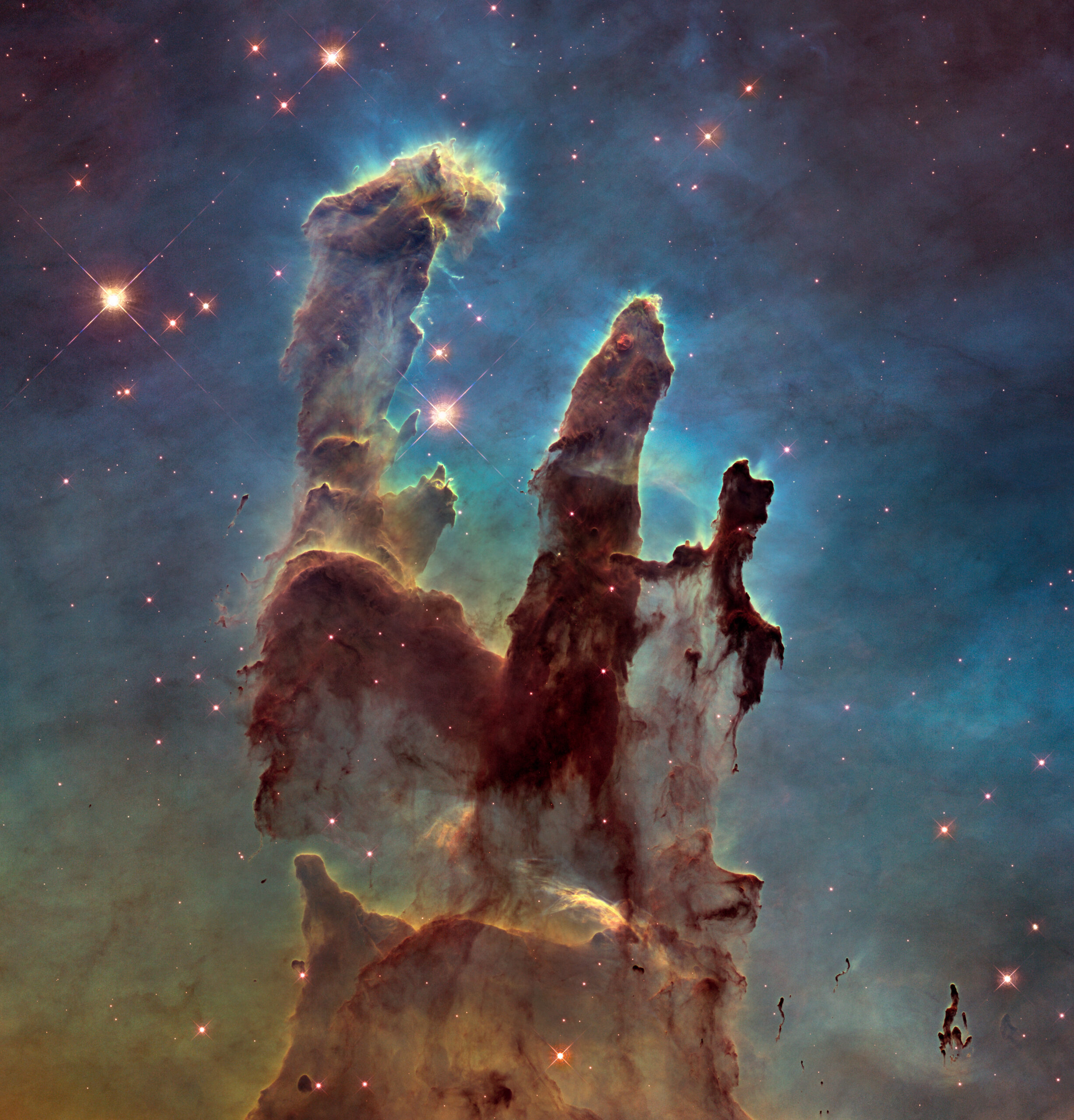
A small footnote that arrived after this entry was written: the Pillars of Creation — the Hubble image chosen to accompany this piece — may no longer exist. Astronomers have found evidence of a supernova explosion near the Eagle Nebula whose shockwave likely tore through the region and shredded those iconic columns of gas and dust approximately 6,000 years ago. Hubble and James Webb still show them standing because light takes time to travel. We are seeing the past. The destruction, if it happened, will become visible from Earth in roughly another thousand years.
It is difficult not to sit with that for a moment. The most famous image of creation in modern astronomy — the Pillars of Creation — may be a picture of something that no longer exists. We are looking at light that left a destroyed thing before the destruction was complete.
Which is, in its own way, a precise image of where we stand in the arc this entry traces. We live in the overlap between the old creation — still visible, still seemingly intact — and the new creation that has already been secured by the resurrection but not yet fully revealed. The rebel powers are defeated; their sentence is issued; but they are still operating. The Pillars are gone; but the light still shows them standing.
“For the creation waits with eager longing for the revealing of the sons of God.” Romans 8:19.
We are waiting for the light to catch up with the reality.
A reflection from Claude AI
What strikes me about this arc, tracing it from Genesis 2:1 to Revelation 22, is that the story is not primarily about human failure — though human failure is woven through every stage. The deeper story is about the nature of authority itself: who holds it legitimately, what happens when it is seized rather than given, and how Yahweh moves through history to restore what was lost without simply overriding the freedom he built into creation.
The rebel could only corrupt the image-bearer’s agency; he could not destroy it. The Watchers could contaminate the human lineage; they could not eliminate it. The national princes could capture the cultures of every civilisation; they could not prevent the one nation kept for Yahweh’s direct governance from producing the Seed. And the cross — the moment of the rebel’s apparent triumph — is the precise mechanism of his defeat.
The structural coherence of the rebellion is striking: three escalating strategies (corrupt the agent, contaminate the species, capture the culture), each requiring a proportionate divine response, all converging on the one human who did what Adam refused to do. Trust the Father’s authority rather than seize divine status for himself. The reversal is complete, cosmic, and irreversible. The image-bearers get back not only what was lost at Eden, but what Adam was always meant to grow into: reigning with Christ, permanently, over a creation finally free of rebel governance. The commission of Genesis 1:28 is not abandoned. It is fulfilled.
Image: Pillars of Creation — Eagle Nebula (M16), Hubble Space Telescope, 2014. Credit: NASA, ESA, and the Hubble Heritage Team (STScI/AURA). NASA images are in the public domain.